A fine timepiece does not photograph itself. It resists. The polished case rejects the room around it; the sapphire crystal swallows whatever you put in front of it and gives back a sky you did not intend. The hands cast hairline shadows that move while you compose. In the world of still life, watchmaking is the most demanding subject because every error of light is recorded twice — once on the metal, once in the metal. The Glashütte Original commission, photographed across studios in New York, Saxony, and Boca Raton between 2018 and 2024, was a long conversation with that resistance.
The brief from Glashütte was not loud. German watchmaking rarely is. The instruction was to honor the movement — the hand-finished bridges, the swan-neck regulator, the double-G logo engraved into the rotor — without theatre. No prop styling that drowned the watch in mood. No painterly grading that softened the metal into jewellery. The frame had to feel like the workbench: cool, exact, and quiet enough that a watchmaker could hear the escapement.
The Movement
Every Glashütte Original timepiece is built to the standard of the German Federal Government's calibre regulations — at least 50 percent of each movement's components must be manufactured in the small town of Glashütte in Saxony, and most are far closer to 95 percent. That fact is invisible to the casual eye, and yet it is the entire reason the pictures exist. The photographs had to suggest, in a single frame, what the watch declares to a watchmaker holding it under loupe: that nothing inside it is borrowed, that the bridges are striped by hand, that the screws are heat-blued in the original way, that the rotor is finished where it cannot be seen.
To do that, you photograph the dial as if it were a face, but you light the movement as if it were architecture. Dials respond to soft, broad, slightly elevated light — a light that traces the printed indices, gathers a single specular highlight at the crown, and lets the second hand cast a shadow precise enough to read the sub-dial through. Movements respond to harder, lower, raked light — light that comes in almost parallel to the bridges, so that the Glashütte stripes catch and the perlage on the main plate begins to shimmer like wet stone. The two languages cannot be spoken at once. Most watch sittings are, at heart, two photographs glued together by patience.
Light Discipline
A camera does not see a watch the way a human does. The eye averages, forgives, fills in. The sensor records every reflection at full strength, including the ones you did not place. The single biggest decision in watchmaking still life is what to put in front of the lens — not behind it. The case is a curved mirror; whatever sits opposite the watch will appear inside it. A black flag will give you a black ring around the bezel; a white card will give you a white one. A printed gradient, used by some of the older Geneva specialists, will give you a soft fall of tone that mimics window light without ever needing window light.
For Glashütte the choice was almost always restraint. A single Profoto strobe through a deep, gridded softbox, raked from camera-left at roughly thirty degrees above the dial. A small fill from a champagne-toned bounce on the right, just enough to lift the shadow side of the case without painting a second highlight on the crystal. A black card directly above to keep the sapphire honest. The polished steel of the Senator Excellence wants to read as steel — silver, cold, slightly blue — and any warmth in the fill must be measured in fractions of a stop.
The macro lens does the rest. At one-to-one reproduction, the depth of field at f/8 collapses to a few millimetres. The focus stack becomes the photograph. A typical Glashütte frame is twelve to forty exposures merged: one for the tip of the minute hand, one for the centre seconds pinion, one for the date window's far edge, one for the lacquered logo, one for the coin-edge knurling on the crown. The merged file is then edited, by hand, at the seam between in-focus and out-of-focus zones, because automatic blending will smear the engraved numerals.
Editorial Practice
An editorial photograph for a watchmaker is not a product photograph. It belongs to a different tradition — closer to a portrait of a luthier's instrument than to a catalogue page. The image has to invite a long look. It has to reward the reader who knows the difference between a Côtes de Genève finish and a Glashütte stripe, and it has to seduce the reader who does not. Most of the work in the studio is invisible in the final frame: the hours of cleaning the crystal with a sable brush, the felted tweezers used to position the strap, the sheet of optically clear glass laid millimetres above the dial to receive the highlight without becoming the highlight.
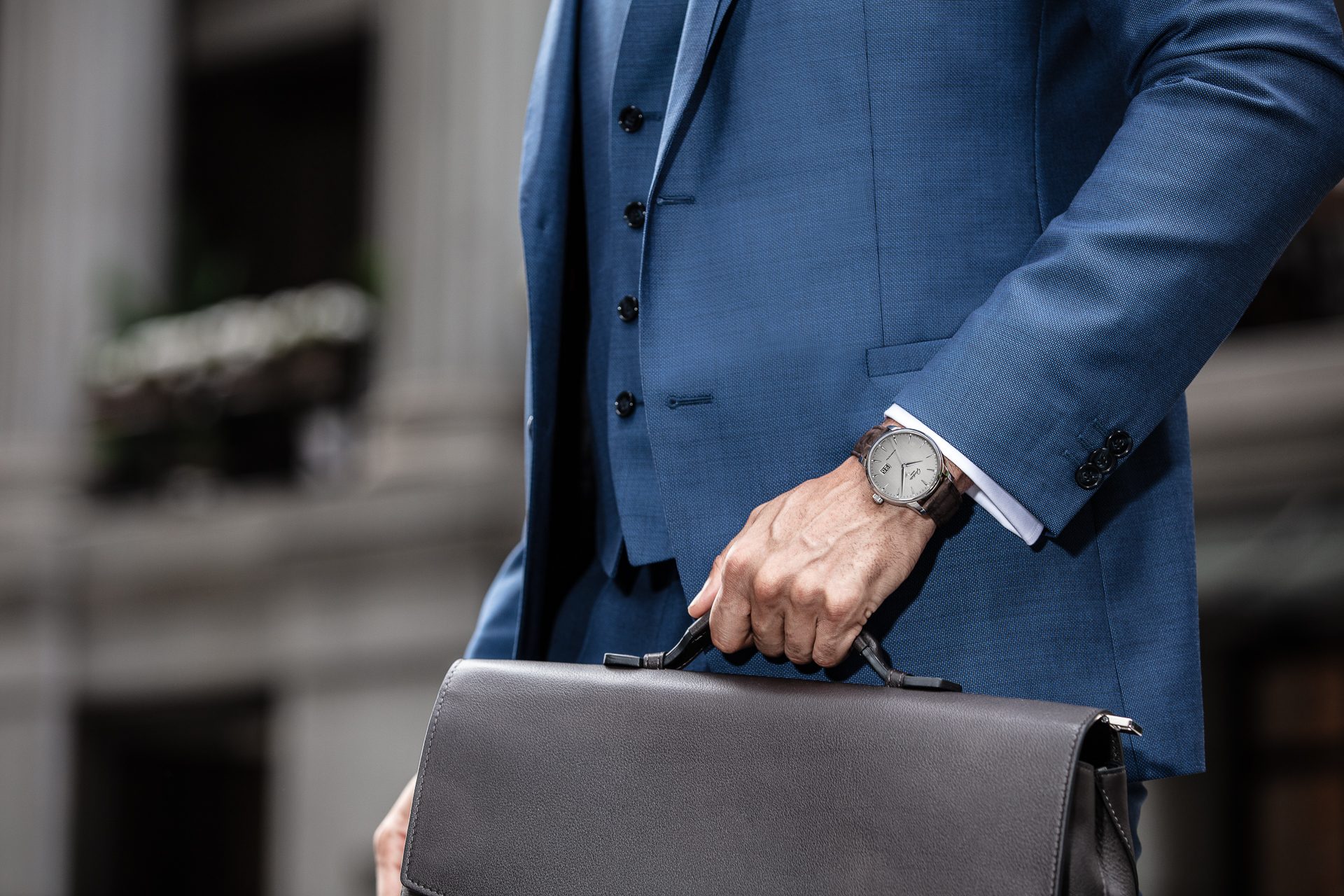
Glashütte's archive runs from the 1845 founding of Ferdinand Adolph Lange's atelier through the post-war re-industrialisation of the Saxon valley, and that history is part of the assignment. A Senator Chronometer is not a sports watch; it is the descendant of a marine chronometer, and the photograph should remember that. The compositions favour stillness over motion, the long horizontal over the dramatic diagonal, the close crop over the wide. A wristshot, when it appears, is treated as a portrait of the wrist as much as of the watch. The strap is given the same attention as the dial — the alligator scales lit so that the printed pattern reads, the stitching counted, the buckle cleaned of every fingerprint before the shutter falls.
Across six years, the work travelled between three studios. The New York sittings handled the editorial portraits, where the watches were paired with Manhattan light through a north-facing window. The Saxony visits — short, polite, instructive — were spent at the manufactory itself, where the photographs of the workbench, the regulator, and the hand-engraved balance cocks could be made in the rooms where the work actually happens. The Boca Raton studio, built inside the Biricik Media facility, became the long-form workshop: the place where focus stacks were assembled, where the colour was matched against a printed reference dial sent from Glashütte, where the final files were prepared for both editorial print and the brand's own archive.
The Workbench as Studio
The most useful thing a watch photographer can do is move slowly. The hands of a fine timepiece are positioned for the photograph by hand, with a brass-tipped pusher and a watchmaker's loupe, and a hand that is one degree off the ten-past-ten convention will read as careless to anyone who works in the trade. The crown is set so the date window shows a number with two digits — fifteen is the convention, twenty-eight in some maisons — to give the small lacquered field a balanced silhouette. The strap is laid in a particular curve, taught from the Geneva schools, that lets the case sit flat without the lugs lifting. None of this is invented on the day. It is rehearsed.
The discipline of watchmaking still life mirrors the discipline of watchmaking itself: small tolerances, repeated. A National Geographic landscape rewards patience for the hour the light arrives; a Glashütte portrait rewards patience for the millimetre the highlight lands. Both are forms of waiting. Both ask the photographer to be quieter than the subject. The work in this volume is offered in that spirit — as an attempt to honour, in two dimensions, an object whose every internal dimension was honoured first by someone else.
Notes on Process
The camera body for the commission was a Canon EOS-1D X Mark III paired with the Canon MP-E 65mm one-to-five macro for the closest movement work, and the EF 100mm f/2.8L IS macro for dial portraits and wristshots. Tethered capture went straight into Capture One, where each focus slice was previewed at 100 percent before the next exposure was taken. The studio computer ran a printed reference dial, sent in advance from Glashütte, alongside the live preview, so colour drift could be caught at capture rather than rescued in post.
Polishing the metal before the shutter is its own ritual. Every Glashütte case received a final pass with a watchmaker's microfibre — never lens tissue, which leaves linear fibres that the macro will record like stitches. The sapphire crystal was breathed on, not sprayed, then wiped in a single motion from the centre outward. A static brush was used last, to lift the dust the cloth had left behind. Once the watch was on the set, no one walked past the table; vibration shows up as a soft halo on the second hand at one-second exposures and as a smeared engraving on anything longer.
The post-production discipline is quieter than the capture. Files are graded against the printed reference until the dial colour matches under both 5500K and 3200K viewing — a sanity check borrowed from cinematography. The retoucher's hand stays away from the engraved markings; if the engraving needs correction, the answer is to relight, not to clone. Composites are limited to the focus stack itself. Nothing is added that was not on the table. Nothing is removed that the watch put there honestly.